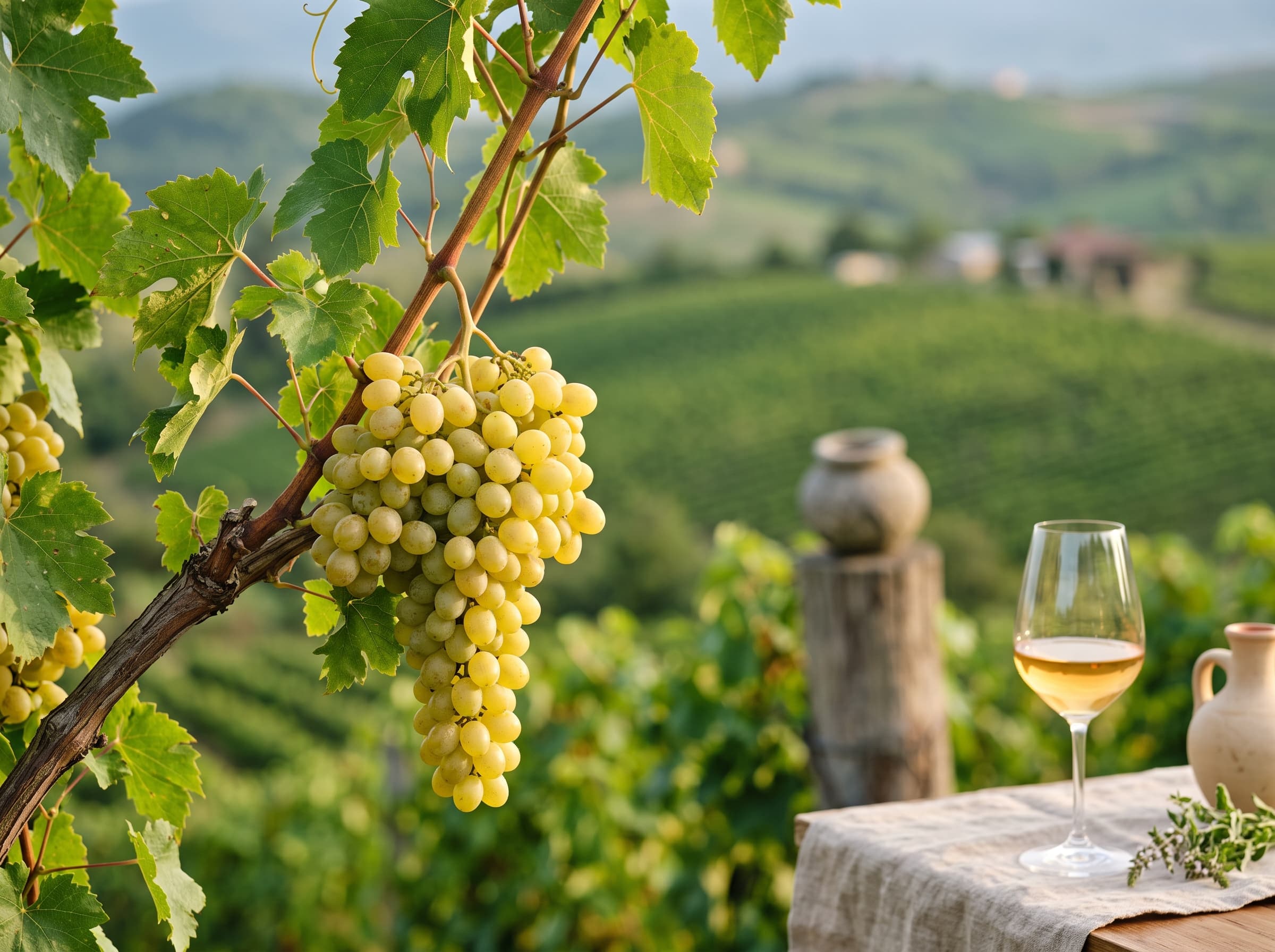
Georgia's vineyards hold hundreds of indigenous grape varieties, and most of them never make it onto an export label. Krakhuna came close to disappearing entirely. By some accounts it was nearly extinct by the 1980s, kept going by a small number of growers in Imereti who had little economic reason to bother with it.6 What survived is one of western Georgia's most distinctive whites, and one that most wine drinkers outside the country have never heard of.
Key Takeaways
- Krakhuna is a rare white grape indigenous to Imereti, western Georgia's cooler wine region, distinct from the Kakhetian varieties most people encounter first.26
- The grape was reportedly nearly extinct by the 1980s and has only been meaningfully replanted since the early 2000s.16
- Krakhuna is particularly susceptible to oidium and suffered heavily from phylloxera, two documented pressures behind its decline.4
- Traditional Imeretian winemaking for Krakhuna uses only partial skin contact within the qvevri, unlike the fuller extraction typical of Kakhetian qvevri wines.5
- Krakhuna flowers late and can build sugar concentrations as high as 30% in central Imereti while holding onto its acidity, which is part of why it ages well.45
What is Krakhuna and where does it grow?
Krakhuna is a white grape native to Imereti, a cooler, wetter region in western Georgia that produces very different wines from the Rkatsiteli and Saperavi most people associate with the country.26 Its exact origins are debated. Some accounts trace it to the Kolkheti valley, while others argue it may have arrived from Kakheti rather than developing locally, and the historical record is thin enough that neither theory has settled the question.4
One detailed account places its traditional home in the villages around Baghdati, in Imereti.5 Krakhuna has long been grown alongside two other local whites, Tsitska and Tsolikouri, and is traditionally blended with them, though single varietal Krakhuna bottlings have become more common as interest in the grape has grown.45
What does Krakhuna taste like?
Krakhuna makes a full bodied white that still manages to hold onto real acidity, which is unusual for a grape capable of building this much sugar. Sourced tasting notes describe pear, quince, dried apricot, and honey, framed by crisp, high acidity.45 Traditional qvevri style Krakhuna tends toward golden color and more textural richness, while modern, European style vinification pulls out brighter, fresher fruit and a cleaner finish.5
Our own Konstantin, a 100% Krakhuna from Imereti, leans further toward banana and lemon, with a clean, crisp finish. If you want a familiar reference point, unoaked Chardonnay is a reasonable comparison for the body and acid structure, though Krakhuna tends to run tropical where Chardonnay runs toward orchard fruit. That comparison is a tasting shorthand rather than a documented equivalence, but it holds up at the table.
Why did Krakhuna almost disappear?
This is the part of Krakhuna's story with the most weight behind it. Phylloxera hit Georgian vineyards hard, and Krakhuna was among the varieties that struggled to recover. On top of that, the grape is particularly vulnerable to oidium, and its resistance to disease seems to shift by region: in Imereti's warm, humid climate it has historically shown more susceptibility, while plantings in drier areas have fared better.4
Krakhuna was once popular well beyond Imereti, cultivated across the wider Soviet Union during that period.4 But its fortunes declined through the Soviet era,3 and by the 1980s it had reportedly become nearly extinct in its home region.6 Serious replanting only picked up from the early 2000s onward.1 Even now, Georgia.to notes that Krakhuna is not as widely cultivated or developed as other Imeretian grapes, and that its full potential in winemaking has not been fully realized.4 What's clear is that its return has been driven by producers who wanted the wine it makes, not by any advantage in growing it. Today it's described as a rare, premium variety with real demand among drinkers looking for something distinctly Georgian.5
How does Imeretian winemaking differ from Kakheti's qvevri method?
Imereti still ferments Krakhuna in qvevri, the same buried clay vessels associated with Kakheti, but the process itself is not identical. Traditional Imeretian winemaking for Krakhuna involves only partial skin contact in the qvevri,5 rather than the extended, fuller maceration typical of Kakhetian qvevri whites like Kisi or Rkatsiteli. The practical effect is a wine that sits lighter in color and gentler in tannin than the deep amber, structured qvevri wines Kakheti is known for, closer to a textured white than to a tannic, skin contact amber.
This regional contrast is genuinely under documented in English language sources, so it's worth treating as a general pattern rather than a fixed rule. What's consistent across accounts is that Imereti's approach to skin contact is measured, not maximal, and that shapes everything from color to how the wine feels on the palate.
Why does Krakhuna age well for a Georgian white?
Krakhuna flowers late in the season, which gives it more time to accumulate sugar before harvest, and it can reach sugar levels as high as 30% in central Imereti while still holding its acidity.4 That combination, high sugar balanced against real acid, is exactly the profile that supports both dry wines with genuine aging potential and semi-sweet or dessert styles.45 Traditional qvevri Krakhuna is specifically noted for its capacity to age well and to pair with seafood or poultry.4
For a Georgian white, that's notable. Most white wines are built to be drunk young. Krakhuna's late ripening and acid retention give it a longer runway.
Our Konstantin, a 100% Krakhuna from Imereti, is one way to taste what nearly disappeared. You can find it in the collection, alongside the rest of our lineup in the wine collection.
Frequently Asked Questions
Is Krakhuna a dry or a sweet wine?
Both. Krakhuna's high sugar potential makes it suitable for classic dry table wines as well as semi-sweet and dessert style wines, and it has historically been used for both.4
What does the name Krakhuna mean?
Most sources tie the name to a word meaning "crisp" or "crispy" in the Imeretian dialect, linked variously to the grape's lively acidity or its thick skin.1256 At least one scholarly account, however, traces the name to a different local word meaning "grain," so the etymology is not fully settled.4
Is Krakhuna usually blended with other grapes?
Traditionally yes. Krakhuna has long been blended with Tsitska and Tsolikouri in Imereti, though it is increasingly bottled as a single varietal wine.45
Where can I try a single varietal Krakhuna?
Konstantin, Lanchava Collection's 100% Krakhuna from Imereti, is a dry single varietal expression of the grape and is available in our collection.
Sources
1. Wines from Georgia - Cellardoor24 2. Georgian grapes - Wineland 3. Georgia - where wine was born, 8000 years ago. - Kinto Natural 4. Discover Krakhuna: A Unique Georgian Grape Variety and Its Winemaking Tradition - Georgia.to 5. Krakhuna Wine History & Origin from Imereti | Memoire Travel To Georgia 6. Krakhuna Grape Variety | WineWiki