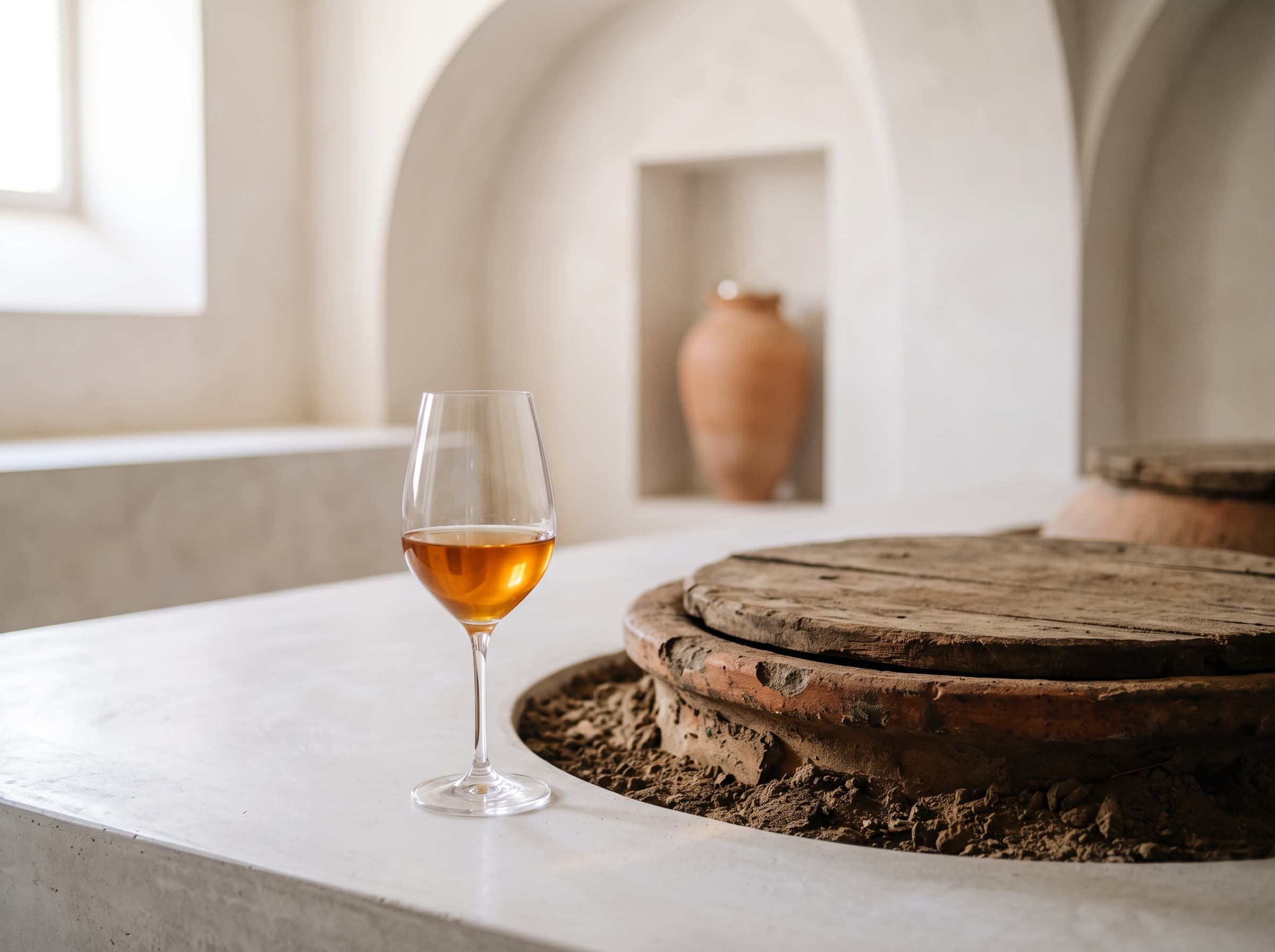
The label on a bottle of skin-contact white wine can read 'orange' or 'amber,' and both are technically accurate in a narrow sense. But the two terms carry different histories, different production timelines, and a cultural gap of roughly eight millennia. Understanding the distinction is not pedantry. It is the difference between a winemaking style and a winemaking civilization.
Key Takeaways
- The term "orange wine" was coined in 2004 by a British wine importer to describe skin-contact whites emerging from Europe and the American West Coast.1
- A 2017 PNAS study led by Patrick McGovern and Stephen Batiuk identified 6000 BC as the earliest known biomolecular evidence of grape wine, originating in present-day Georgia.2
- Western orange wine typically involves days to a few weeks of skin contact, while Georgian amber wine can macerate on skins, stalks, and pips for up to 12 months.15
- Georgian amber wine is traditionally fermented, matured, and stored entirely within a buried qvevri, an earthenware vessel that holds a steady 14 to 15 degrees Celsius without mechanical refrigeration.2
- The qvevri winemaking tradition earned a spot on UNESCO's Intangible Cultural Heritage list in 2013, though only about 5% of Georgian wine is currently made using this method.5
Where the Term 'Orange Wine' Actually Comes From
The phrase 'orange wine' is a modern coinage, invented in 2004 by a British wine importer to describe skin-contact wines then emerging from Europe and the American West Coast.1 The name referenced the color these wines took on after brief skin contact: a pale golden hue, closer to amber than orange in practice, but the label stuck.
At that point, Georgia had been behind the Iron Curtain for decades, its winemaking largely invisible to Western wine culture.1 When the skin-contact revival happened in Italy, Slovenia, and California, 'orange' became the catch-all. Georgian amber wine, which had existed continuously for thousands of years, was absent from that conversation and therefore absent from its vocabulary.
The result is that a category named in 2004 became the generic term for a practice Georgia had been refining since at least 6000 BC. A 2017 study published in the Proceedings of the National Academy of Sciences, led by Patrick McGovern and Stephen Batiuk, identified that date as the earliest currently known biomolecular evidence of grape wine, placing its origin in present-day Georgia.2
The Technical Gap Between Amber and Orange
Both styles share one foundational technique: grape skins remain in contact with the juice during fermentation, rather than being removed immediately as in conventional white winemaking.134 That is where the overlap largely ends.
In Western orange wine production, skin contact typically lasts days to a few weeks.1 In Georgian amber wine production, it can extend up to 12 months, and the maceration often includes not just skins but stalks and pips as well.15 That extended contact extracts far more tannin, pigment, and aromatic complexity. The resulting wine is not a subtle variation on white wine. It is a structurally different product: deep copper in color, tannic, full-bodied, and often described as tasting of dried fruit, honey, spice, and a faint nuttiness.14
The vessel matters too. Georgian amber wine made in the traditional style is fermented and matured in a qvevri, a large egg-shaped earthenware vessel, handmade from local clay, lined internally with beeswax, and buried almost entirely underground in the cellar floor.2 The buried qvevri maintains a stable temperature of around 14 to 15 degrees Celsius year-round without any mechanical refrigeration. Its fired clay allows a measured exchange of oxygen, similar to oak, but without contributing any wood-derived aromas or flavors.2 The egg-shaped base promotes natural settling of skins and solids as fermentation slows, clarifying the wine without filtration.2
A qvevri ferments, matures, and stores wine in a single vessel.2 It is not a tank or a barrel used for one step in the process. It is the entire process in one piece of clay. For our own Amber, a dry Kisi made in Kakheti, the qvevri is exactly that: the method and the vessel are inseparable.
Western orange wine, by contrast, can be made in any vessel. Clay, steel, or wood are all used.4 The approach borrows a technique; it does not inherit a system.
Why Georgian Winemakers Reject 'Orange'
Georgian winemakers, as a general practice, do not use the term 'orange wine' to describe their wines.5 The preference for 'amber' is not marketing. It is a refusal to subsume a specific, millennia-old tradition under a label invented for a recent Western trend.
One way to frame it: all Georgian amber wine can be described as orange wine under the modern definition, but not all orange wine reflects the historical depth of Georgian amber wine.3 The term 'orange wine' treats skin contact as the defining characteristic. Georgian producers would argue that skin contact is the minimum, not the definition. What defines amber wine is who made it, in what vessel, for how long, and as part of what cultural lineage.
That lineage has formal recognition. The qvevri winemaking tradition was inscribed on UNESCO's Intangible Cultural Heritage list in 2013. No equivalent institutional recognition exists for orange wine as a production method.
It is also worth noting that only approximately 5% of Georgian wine is currently made in qvevri.5 Amber wine produced in this way is not abundant. It is a continuation of a specific craft practiced by a small number of producers, with the technique itself requiring up to six weeks to build a single vessel.
A Note on What 'Amber Wine' Does and Does Not Mean
Some sources use 'amber wine' more broadly to describe any skin-contact white wine regardless of vessel or origin, and no universally regulated definition exists.4 This is worth naming clearly. When Georgian producers and wine educators use 'amber wine,' they are referring specifically to wines made from white grapes with extended skin contact in qvevri, carrying the full weight of Georgian tradition. When used more loosely in the broader wine world, it can simply mean skin-contact white wine of any origin.
The distinction matters when you are reading a label or a wine list. An orange or amber wine from a modern European producer may be genuinely interesting and well made. It is a different object from a Georgian qvevri wine with months of skin maceration.
If you want to explore what that tradition actually tastes like, the collection is a reasonable place to start. And if the cultural context behind the glass is as interesting to you as the wine itself, the supra and the role of the tamada in Georgian wine culture offer another angle on why wine in Georgia has never been purely a beverage.
Frequently Asked Questions
How long does it take to make a qvevri?
Crafting a single qvevri is a slow, handmade process that can take up to six weeks. Each vessel is shaped from local clay and later lined internally with beeswax before being buried in the cellar floor.
What does Georgian amber wine taste like?
Extended skin contact gives amber wine a deep copper color along with a tannic, full-bodied structure. Common tasting notes include dried fruit, honey, spice, and a faint nuttiness.14
Does orange wine have to be made in a qvevri?
No, Western orange wine can be produced in clay, steel, or wood vessels.4 This is one of the key differences from Georgian amber wine, which is traditionally inseparable from the qvevri itself.2
How much Georgian wine is actually made in qvevri today?
Only around 5% of Georgian wine currently comes from qvevri production.5 That makes traditional amber wine a small, specialized craft rather than a widespread category.
Sources
1. What is the Difference Between Amber Wine and Orange Wine – Ghvinos Wines 2. Qvevri: The ancient vessel at the heart of Georgian winemaking | WSET 3. Amber vs White Wine: Key Differences Explained – De Georgie 4. Exploring Orange Wine: A Guide to Georgian Amber Wine – Eat This Tours 5. Georgian Amber Wine Guide: Discover the Ancient Art of Qvevri Winemaking