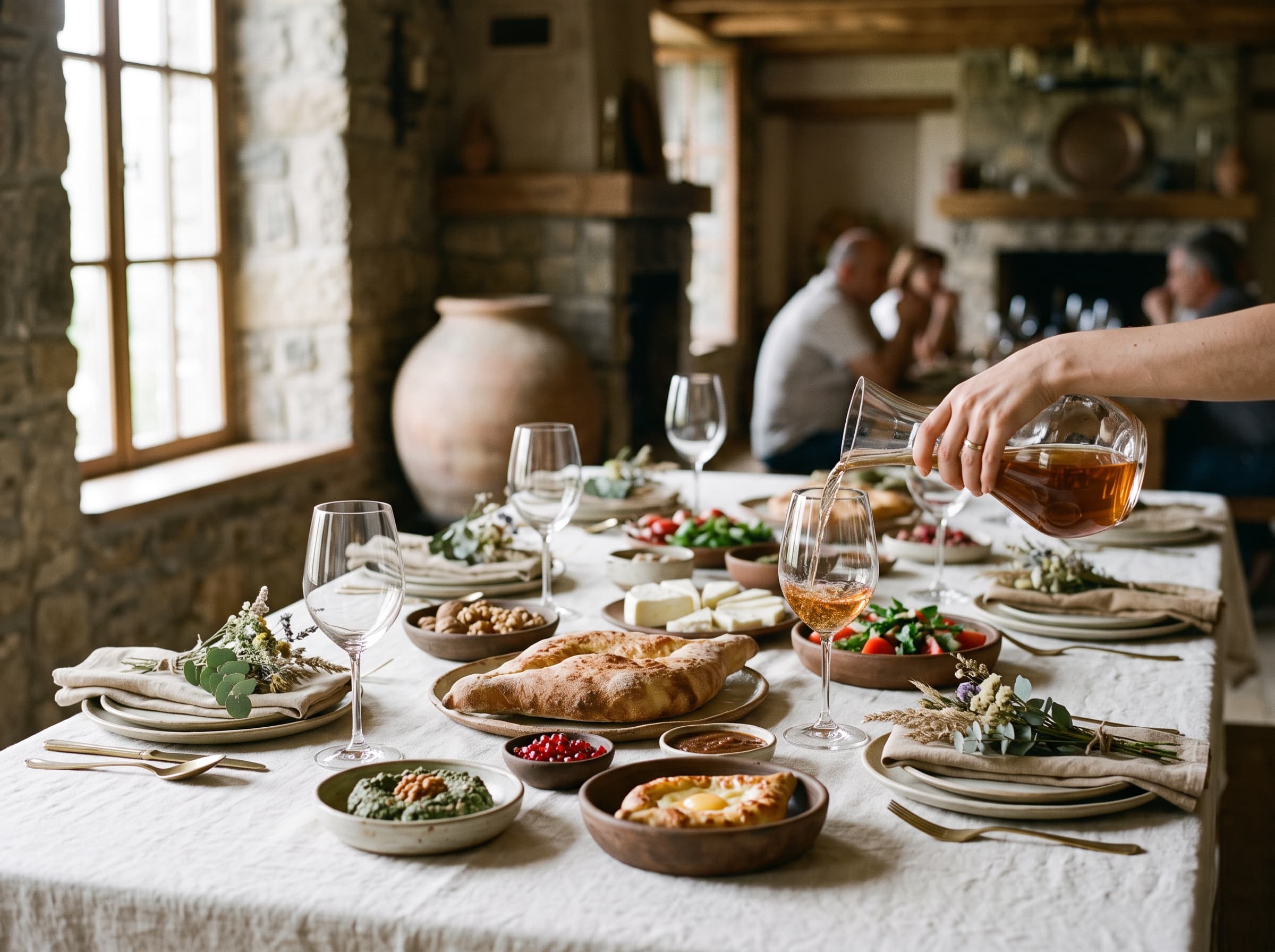
A Georgian supra looks, at first glance, like an especially generous dinner party: too much food, too much wine, too much noise. It is actually closer to a performance with its own liturgy. Someone leads it. Toasts follow a rough order. Guests have roles, whether they know it or not. Understanding that structure is the difference between attending a supra as a spectator and hosting one that actually works.
The word itself is deceptively simple. "Supra" (სუფრა) translates literally to "tablecloth," but it refers to the entire feast tradition built around that table.4
Key Takeaways
- The word "supra" literally means "tablecloth" in Georgian, but it refers to the entire feast tradition built around the table.4
- Georgian feasts come in two main forms: keipi, a joyful supra for weddings and holidays, and kelekhi, a more somber memorial or funeral feast, both led by a toastmaster at his own pace.4
- A supra's four essential elements are toasts, wine, bread, and song, and as long as all four are present, the size of the gathering matters little.31
- Over a full-day supra, a tamada may drink well over three litres of wine, a demand made manageable by the traditionally small glasses, often around 75ml per pour.1
- The toast sequence typically opens in the name of God, moves to a toast for Georgia, includes an alaverdi invitation for a guest to add their own words, and closes with a toast to all saints followed by a final toast to the tamada himself.215
Two Kinds of Feast, One Backbone
Not every supra carries the same tone. One source distinguishes between keipi (ქეიფი), a joyful supra held for weddings and holidays, and kelekhi (ქელეხი), a more somber memorial or funeral feast.4 The mood shifts, and the toasts lean more reflective at a kelekhi, but the basic mechanics stay the same: a toastmaster leads, wine flows in rounds, and the meal moves at his pace.4
The supra is also described by some as Georgia's most sacred social institution, with one source noting its status as UNESCO Intangible Cultural Heritage.4 That claim appears in only one source in our research, so treat it as reported rather than universally confirmed, but it reflects how seriously Georgians take the tradition.
One useful way to think about what a supra actually requires: toasts, wine, bread, and song. These are sometimes called the feast's four pillars, and if you have all four, the size of the gathering barely matters.31 A supra of six people around a kitchen table follows the same logic as one with sixty.
The Tamada Is Not Just a Toastmaster
Every supra needs a tamada, and the feast is genuinely difficult to imagine without one.1 The tamada leads every toast, sets the order in which they happen, and decides when the table moves from one theme to the next.2 He is also responsible for keeping the tone positive. Toasts at a supra are meant to be uplifting, even when the subject is serious, and it falls to the tamada to hold that mood.5
The tamada doesn't have to be the host. A host can choose anyone they consider fit for the role, and in many communities, certain men become the regular tamada of choice across multiple gatherings.5 If you're hosting a supra yourself and don't feel equipped to lead it, choosing a confident, generous tamada and stepping back is entirely traditional.
The role also carries a real physical demand. Over the course of a long, full-day supra, a tamada may drink well over three litres of wine, though the small glasses traditionally used (often described as roughly 75ml pours) exist partly to make this manageable.1 If tradition is followed strictly, the tamada may be the only person permitted to initiate a toast, and he's expected to finish his glass after each one he gives.6
For a closer look at what the role demands and how it's earned, our tamada page goes into more detail.
The Rough Order of Toasts
No single source lays out a complete, fixed sequence of every toast in a supra, and dish order and toast order can shift by region and occasion.2 But a few points in the sequence appear consistently.
The first toast is made in the name of God, reflecting Georgia's Orthodox Christian tradition. The tamada may open with a short prayer or a reflection on faith's place in daily life.15
A toast to Georgia itself typically follows. If a foreigner is at the table, the tamada is expected to fold that guest's home country into the toast, a small but deliberate gesture of inclusion.5
Partway through, the tamada may offer an alaverdi, an invitation for a guest to build on the toast just given and add their own thoughts.2 This is worth understanding correctly: it's an invitation the tamada extends, not an open floor. Guests don't typically start toasts on their own initiative.62
If someone arrives late, after the first toast has already been made, don't expect quiet forgiveness. Custom holds that the tamada will make a toast in the latecomer's name, gently teasing them in front of the table.1
Toward the end of the evening, a closing toast called kvelatsminda (to all saints) is drunk, and the final toast of the night is made to the tamada himself, closing the loop on everything he's led.2
As for how long all this takes: expect variation. Some sources describe a typical supra running three to six hours, with others noting they can stretch well beyond that, and toast counts anywhere from a dozen to twenty or more over the course of the meal.436 Don't plan a supra expecting it to wrap up quickly.
Hosting One Yourself
If you're putting together your own supra, a few practical habits carry more weight than any single toast script.
Keep the table full. An empty plate, or worse, an empty table, is considered discouraging, even a little shameful, and a good host or hostess keeps replenishing food throughout the night rather than serving in tidy courses.31 Dishes tend to arrive in no particular order, which is part of the point: abundance, not sequence, is the goal.3 The breadth of a well-stocked Georgian table has been compared to a Lucullan feast, and desserts like buffalo matsoni with honey, churchkhela, tatara, and dried fruits usually round things out.2
Keep the wine within reach but let the toasts control the pace. Pitchers or bottles are typically placed around the table so glasses can be refilled quickly, and the custom is to drink only after the tamada gives a toast, not on your own schedule.6 If you're hosting foreign guests, it's fair to explain this up front: visitors are given some latitude to decline wine or drink modestly, and this is accepted without much fuss.6 Traditional wine horns sometimes make an appearance for a particular toast, though they aren't required.6
For the wine itself, variety is part of the tradition rather than a departure from it. A supra table might reasonably carry a dry Rkatsiteli, a Saperavi, a semi-sweet red, and something amber alongside them, since Georgian feasts have never been built around a single grape or style.2 If you're assembling your own table, a dry Saperavi like Luka pairs naturally with the heavier dishes, while a Kisi such as Amber or the semi-sweet Anastasia gives guests something to move to as the toasts turn softer later in the night.
Finally, don't underestimate the songs and stories. A good supra is threaded with poems, tales, and often polyphonic singing, guitar-backed or a cappella, and the tamada usually decides when the table shifts from toasting into that kind of storytelling.23 It doesn't need to be rehearsed. It needs someone willing to start.
Hosting a supra well isn't about memorizing a script. It's about understanding that the toasts, the wine, the food, and the songs are all doing the same job: keeping the table generous, unhurried, and led by someone who takes that responsibility seriously.
Frequently Asked Questions
What does a tamada actually do at a supra?
The tamada leads every toast, decides the order in which they happen, and controls when the table shifts from one theme to the next.2 He is also responsible for keeping the tone of the toasts positive, even when the subject matter is serious.5
Can guests give their own toasts at a supra?
Traditionally, no. If the custom is followed strictly, the tamada is the only one permitted to initiate a toast, and guests only speak when he extends an alaverdi, an invitation to build on a toast he has just given.62
How long does a typical supra last?
Accounts vary, but a supra commonly runs three to six hours and can stretch well beyond that, with toast counts ranging from around a dozen to twenty or more over the course of the meal.436
What happens if a guest shows up late to a supra?
Custom holds that the tamada will make a toast specifically in the latecomer's name, typically with some gentle teasing in front of the rest of the table.1
Sources
1. The Role of the Tamada and Traditional Georgian Toasts 2. Georgian Supra | Georgia Travel 3. The Toasts Of Georgian Supra (Feast) & The Tamada (Toastmaster) - EAT THIS! Tours 4. The Georgian Supra: A Complete Guide to Feasting, Toasting & Surviving Your First (2026) | Georgia Expats 5. The Ultimate Guide to Georgian Supra and Toasts - Tour Guide Georgia 6. Georgian Supra Traditional Wine Feast