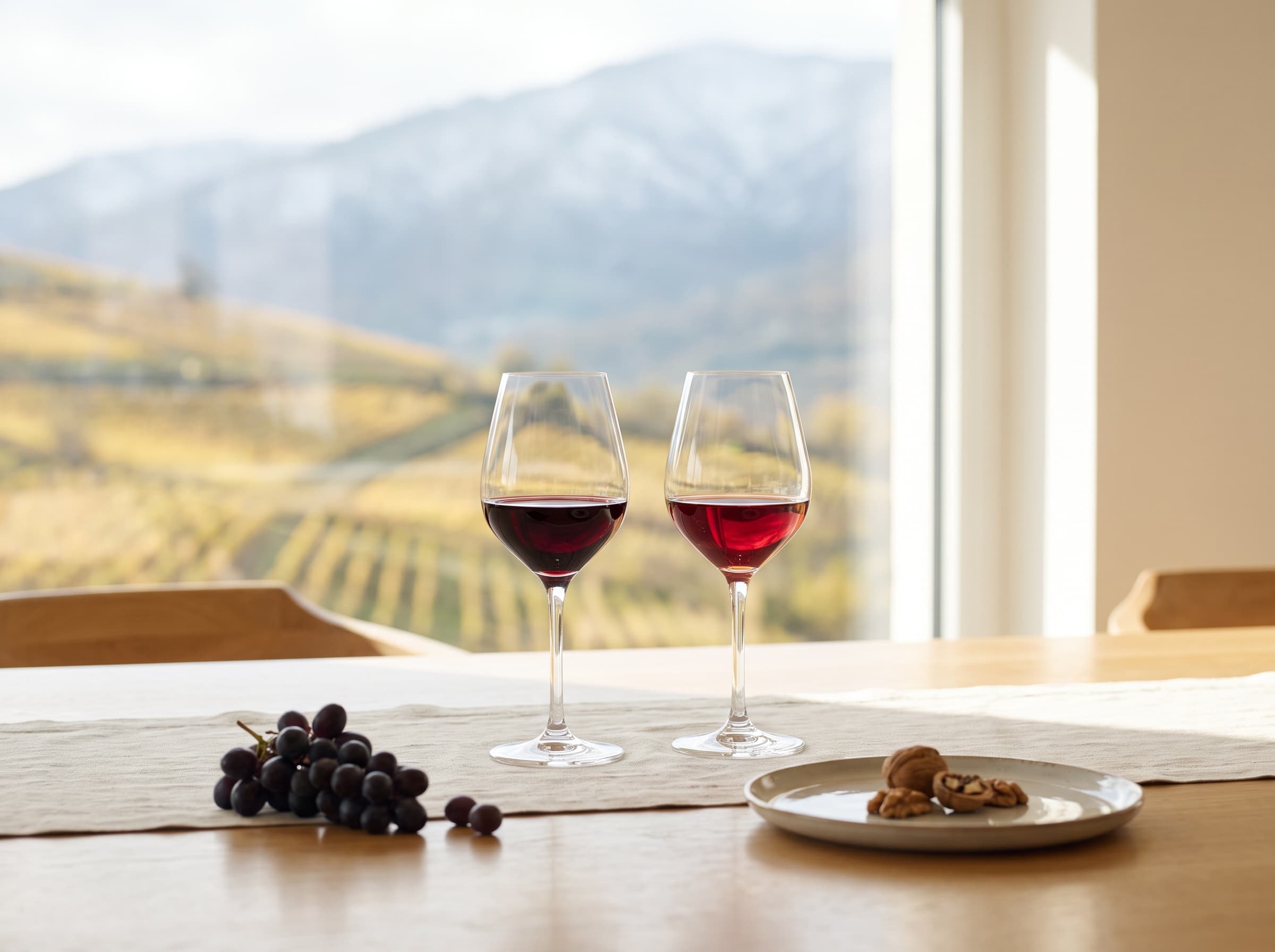
Kindzmarauli and Khvanchkara show up on the same wine lists, get ordered by the same curious drinker, and are routinely mixed up. Both are Georgian semi-sweet reds with Protected Designation of Origin status.135 That is roughly where the similarities end. They come from opposite corners of the country, they're made from entirely different grapes, and they taste like it.
Here is the short version, then the detail.
| Kindzmarauli | Khvanchkara | |
|---|---|---|
| Region | Kvareli, Kakheti (Alazani Valley)1245 | Racha, western Georgia145 |
| Grape | 100% Saperavi1235 | Aleksandrouli & Mujuretuli blend135 |
| Character | Bold, dark-fruited, firmer tannin125 | Elegant, bright-fruited, softer tannin15 |
| Best with | Grilled and smoky meats, BBQ5 | Charcuterie, soft cheese, fruit desserts5 |
| Try | Anastasia | Nicholas |
Key Takeaways
- Kindzmarauli and Khvanchkara are both Georgian semi-sweet red wines with Protected Designation of Origin status.135
- Kindzmarauli is made exclusively from Saperavi grown in the Kvareli microzone of Kakheti's Alazani Valley, while Khvanchkara comes from a blend of Aleksandrouli and Mujuretuli grown in the cooler, higher-elevation Racha region.12345
- Kindzmarauli's PDO rules require residual sugar between 30 and 80 grams per litre and alcohol between 10.5% and 13%, with sweetness coming from arrested fermentation rather than any added sugar.2
- Kindzmarauli tends toward dark fruit, deep ruby color, and firmer tannin, while Khvanchkara pours lighter with bright red fruit, floral notes, and softer tannin.125
- Kindzmarauli carries Soviet-era prestige as a wine reportedly favored by Stalin and once exported to Moscow and St. Petersburg.2
Two Regions, Two Climates
Khvanchkara comes from Racha, a mountainous, higher-elevation part of western Georgia in the foothills of the Lesser Caucasus, with well-drained, rocky soils and a noticeably cooler climate.145
Kindzmarauli comes from a single legally defined microzone in the Kvareli district of Kakheti, on the floor of the Alazani Valley in eastern Georgia.1245 That valley-floor position sits lower than most Kakhetian vineyards, and the extra warmth pushes grapes toward higher natural sugar accumulation, one of the reasons Kindzmarauli reaches its sweetness level so reliably.2
The terroir contrast explains a lot of what follows. Cool, high-elevation fruit tends toward lighter color and brighter acidity. Warm valley-floor fruit tends toward density and richness.
The Grapes Behind Each Wine
Khvanchkara is traditionally a blend of two indigenous Georgian varieties: Aleksandrouli and Mujuretuli.135 Aleksandrouli brings the aromatic lift, red fruit and floral tones. Mujuretuli fills in body, color, and structure.1 Together they produce a wine that leans elegant rather than powerful.
Kindzmarauli is made exclusively from Saperavi grown within its designated microzone.1235 Wine made from Saperavi elsewhere in Georgia, however it's labeled, is not genuine Kindzmarauli. Saperavi is a teinturier grape, meaning the flesh carries pigment along with the skin, which is why Kindzmarauli holds onto deep color and a firm structure even at semi-sweet sugar levels.1
Where the Sweetness Actually Comes From
Neither wine gets its sweetness from added sugar. Kindzmarauli's PDO rules specify residual sugar between 30 and 80 grams per litre and alcohol between 10.5% and 13%,2 and that sweetness is the result of arrested fermentation, cooling the wine to stop yeast activity before all the natural sugar converts to alcohol, rather than any sugar addition at any stage.2
How that arrest happens depends on who you ask. One account describes modern, temperature-controlled tank production with precise monitoring.2 Another describes a more traditional Kakhetian method in qvevri, where the mezga (skin and pulp) is left to settle rather than removed, signaling to the winemaker that fermentation has run its course, followed by aging until at least spring, longer for reserve styles. Both approaches likely exist across different producers, so it's more accurate to treat this as a house-style variation than a single fixed method.
Khvanchkara's traditional style also relied on natural residual sugar, partial fermentation left as-is by producers with a lighter touch, though modern producers increasingly use controlled temperature management to manage the same result.1 Both wines can be made in tank or barrel, with qvevri playing a more central role in Georgian white winemaking than in these two reds, though some producers do experiment with it for texture.1
Tasting Profile: Bold vs Bright
Khvanchkara tends to pour lighter in color, with bright red fruit (raspberry, red cherry, sometimes pomegranate or cranberry), floral notes of rose or wildflower, a touch of spice or earth, and soft, supple tannins. The sweetness is kept in check by fresh acidity, so it reads as lively rather than heavy.15
Kindzmarauli runs darker: black cherry, plum, blackcurrant or blackberry depending on the vintage and producer, deep ruby in the glass, with a firmer tannic backbone than Khvanchkara. The finish is long, layered with dark fruit and subtle spice, and carries real warmth.125
When to Serve Each
Kindzmarauli is built as a table wine, not a dessert wine, and its natural home is the rich, walnut-and-meat cuisine of the Georgian supra.2 In practice, that means it holds up well against spicy grilled or barbecued meats, glazed dishes, burgers, and anything with real char.5 Its sweetness can also work with dessert, since it favorably lifts the flavor of what's on the plate, but its main job is at dinner, not after it.
Khvanchkara leans toward lighter company: charcuterie, soft cheeses, and fruit-based desserts, where its brighter fruit and softer tannin have room to show.5
For a sense of the style at home, Anastasia is a Saperavi-based semi-sweet red from Kakheti built in the Kindzmarauli mold, dark ruby, rich with ripe cherry tones. Nicholas follows the Khvanchkara blueprint: Aleksandrouli and Mujuretuli from Racha, semi-sweet, with velvety berry notes and a more balanced, gentler sweetness.
A Note on Reputation
Kindzmarauli's prestige has Soviet-era roots. It was among the most sought-after Georgian wines for export to Moscow and St. Petersburg,2 and it's reportedly the wine Stalin, Georgian by birth, favored and requested from his native Gori.2 Some accounts go further, describing an early limited-edition version reserved for Communist Party elites and labeled simply "wine No. 2". Treat this as wine-world legend rather than settled history, it's been passed down more than it's been documented, but it explains why Kindzmarauli still carries a certain cachet on Georgian wine lists.
The Short Answer
If you want bold, dark-fruited, and structured, choose Kindzmarauli. If you want something more elegant, aromatic, and soft-textured, choose Khvanchkara.5 Both are proof that "semi-sweet" in Georgian wine covers a much wider range than the term suggests. To taste the fuller spectrum, the full collection is a reasonable place to start.
Frequently Asked Questions
Is Kindzmarauli sweeter than Khvanchkara?
Both wines fall into the semi-sweet category, but Kindzmarauli's PDO rules set a defined residual sugar range of 30 to 80 grams per litre, achieved through arrested fermentation rather than added sugar.2 Khvanchkara relies on a similar natural residual sugar approach, though its sweetness is balanced by fresh acidity that keeps it tasting lively rather than heavy.15
Can Kindzmarauli be made anywhere in Georgia?
No. Genuine Kindzmarauli must be made from Saperavi grown specifically within its designated microzone in the Kvareli district of Kakheti, and Saperavi produced outside that zone cannot legally be labeled Kindzmarauli regardless of how it's marketed.1235
Does qvevri play a big role in making these two wines?
Not as central a role as it does in Georgian white winemaking. Both Kindzmarauli and Khvanchkara can be produced in tank or barrel, and while some producers experiment with qvevri for added texture, it is not the defining method for either wine.1
What food pairs well with Kindzmarauli?
Kindzmarauli is meant to be a table wine rather than a dessert wine, and it pairs especially well with spicy grilled or barbecued meats, glazed dishes, burgers, and other charred foods.25 It can also complement dessert, since its sweetness lifts the flavors of what's on the plate, but its primary role is at the dinner table.
Sources
1. Khvanchkara vs Kindzmarauli: Which Georgian Wine to Choose? 2. Kindzmarauli Marani: inside Georgia's famous semi-sweet red wine zone 3. Meamani Kindzmarauli 750ml | Georgian Semi-Sweet Red Wine 4. Khvanchkara - Georgian Wine Shop 5. Kindzmarauli vs. Khvanchkara: What's the Difference?