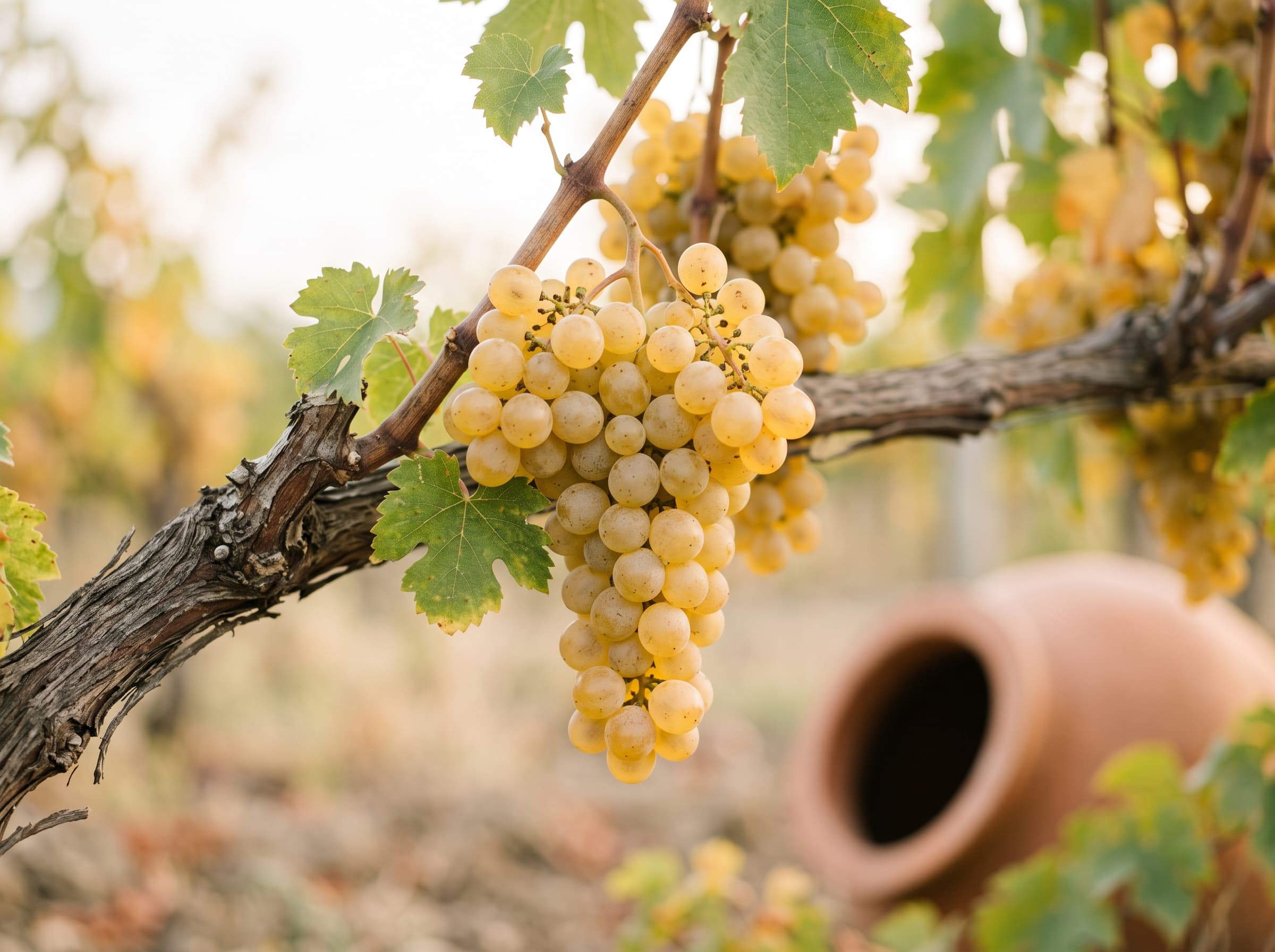
Kisi almost vanished from Georgian vineyards around the turn of this century. Today it is one of Kakheti's most closely watched white grapes, capable of three distinct wine styles from the same fruit. Understanding what makes it different starts with its uncertain origins and its close, tangled relationship to two other Georgian whites.
Key Takeaways
- Kisi is a native Georgian white grape grown mainly in the Telavi and Gurjaani districts of Kakheti, in villages such as Ikalto, Napareuli, and Bakurtsikhe.345
- Kisi nearly disappeared around 2000 due to phylloxera damage and vulnerability to powdery mildew and black rot, but has since seen a quality-driven revival.46
- Kisi's natural sugar content can reach up to 30 percent, which is why it lends itself so naturally to semi-sweet wine styles.3
- Kisi is often treated as a natural hybrid of Rkatsiteli and Mtsvane, sharing leaf shape with the former and berry color and aroma with the latter.34
- Kisi produces three genuinely different wines: a crisp dry white, a rich qvevri-aged amber, and a floral, stone-fruit semi-sweet.146
What is the Kisi grape and where does it come from?
Kisi is an indigenous white grape variety cultivated almost entirely within Kakheti, Georgia's main wine region.1345 Its stronghold is a cluster of villages in the Telavi and Gurjaani districts, including Ikalto, Ruispiri, Kistauri, Khodasheni, Akhmeta, Napareuli, and Bakurtsikhe.345
How old the variety actually is remains genuinely unsettled. One source describes Kisi as a comparatively recent arrival in Georgia's viticultural landscape without offering a date.3 Another places its roots around 500 AD while, in the same breath, calling this a sign of relative youth among Georgian grapes and admitting its exact origins are unverified.4 Rather than picking a side, it's worth treating any specific age for Kisi as an open question, not a settled fact.
What is better documented is its likely parentage. Kisi is widely regarded as a natural hybrid of Rkatsiteli and Mtsvane, both long-established Kakhetian whites.34 Its leaves resemble Rkatsiteli's, while its berry color and aromatic character lean toward Mtsvane.34 Botanically, its vines are classified among the eco-geographic grape varieties of the Black Sea basin, and it takes roughly 140 days from budding to full ripeness.3
How does Kisi differ from Rkatsiteli and Mtsvane?
The clearest practical difference is sugar accumulation. Kisi can reach sugar levels of up to 30 percent, a trait that pushes winemakers toward semi-sweet styles in a way that neither of its presumed parent grapes does as naturally.3 That single fact explains a lot about how the variety is used today, from stainless-steel semi-sweet bottlings to fuller qvevri wines.
Yield is the other defining contrast. Kisi produces 25 to 30 percent less fruit than Rkatsiteli, a gap that made it economically less attractive to replant after Georgia's phylloxera crisis and contributed directly to its near disappearance.4 Combine that with its vulnerability to powdery mildew and black rot, and it's easy to see why growers leaned toward hardier, higher-yielding Rkatsiteli for most of the 20th century.4 Winemakers today still frequently blend Kisi with Rkatsiteli and Mtsvane Kakhuri, using its aromatics to add lift to more neutral base wines.4
Our George (100% Rkatsiteli) and Saba (100% Mtsvane) sit on either side of Kisi's parentage, if you want to taste the family resemblance directly.
What's the difference between semi-sweet and amber Kisi wine?
Dry Kisi and qvevri amber Kisi are close to being two different wines from the same grape. Classic dry, tank-fermented Kisi is crisp and medium-bodied, showing flowers, citrus, apple, pear, and peach, with a light straw color and a clean apple-driven finish.34 Qvevri-aged amber Kisi, made through extended skin contact in Georgia's traditional buried clay vessels, is a different animal entirely: darker in color, fuller-bodied, and layered with orange peel, apricot, honey, spice, and nuts, with a light tannic grip from the skins.46
Semi-sweet Kisi sits closer to the aromatic end of the spectrum. A representative example, Kisi Semi-Sweet from Kakheti at 12% ABV, shows light golden color, aromas of peach, apricot, honey, citrus zest, and florals, with a palate of honeyed pear and peach, tropical fruit, and a spice note, all balanced against crisp acidity and a citrus-floral finish.1 That style is typically fermented in stainless steel with fermentation deliberately stopped to preserve natural residual sugar,1 and it's served best chilled, as an aperitif or alongside light desserts, fruit salads, and soft cheeses.1 Our Mariné follows this semi-sweet Kisi profile, while our Amber is made from 100% Kisi using the traditional qvevri method for the fuller, skin-contact style.
Across all three expressions, tasters note tropical fruit (mango, pineapple, papaya, passion fruit) and warm spice (nutmeg, ginger, clove) as recurring signatures, along with genuine ageing potential: well-made Kisi tends to gain complexity and a honeyed edge over time while keeping its underlying freshness.6
Is there a familiar US wine comparable to Kisi?
There isn't a direct varietal equivalent on American shelves, and no credible source claims one. Kisi remains rare internationally simply because so little of it is planted, which keeps it firmly in insider-tip territory rather than mainstream distribution.6 What can be said honestly is descriptive: its combination of stone fruit, tropical aromatics, floral lift, and (in qvevri form) light tannin and honeyed depth puts it in aromatic-white territory that drinkers of richer, more textured whites may find familiar ground in, without it being a stand-in for any single grape. The more useful comparison is internal to Georgia itself, since Kisi's blend of Rkatsiteli structure and Mtsvane aromatics already gives it a built-in point of reference.34
Frequently Asked Questions
Is Kisi wine sweet or dry?
Both exist. Kisi is made as a crisp dry white, a full-bodied qvevri amber wine, and a semi-sweet style with retained natural sugar, so the grape itself is not inherently one or the other.14
Why did Kisi almost disappear?
Kisi was hit hard by the phylloxera crisis and is more vulnerable than many Georgian grapes to powdery mildew and black rot, and its yield runs 25 to 30 percent lower than Rkatsiteli, making it less appealing to replant.4 It has since undergone a notable revival driven by renewed interest in traditional Georgian winemaking.46
What food pairs well with Kisi wine?
Dry Kisi works well with salads, seafood, and cheese, while qvevri amber Kisi suits chicken, creamy sauces, and spicier dishes, and semi-sweet styles pair naturally with light desserts and soft cheeses.14 Amber Kisi also holds up to Asian cuisine and grilled, spice-marinated meats.6
Can Kisi wine age well?
Yes. Kisi is noted for genuine ageing potential, developing added complexity and a honey-like character over time while retaining its natural freshness.6
Sources
1. Winiveria - Kisi Semi Sweet | Wine Delivery | Georgian wine 3. Kisi Grapes – Tours to Uzbekistan & Central Asia & Caucasus 4. Discover Kisi: Revival of Georgia's Native Grape Variety in Kakheti's Wine Industry 5. Kisi amber wine from Georgia. Another 8000 year-old delight. 6. Kisi – The exotic seducer with a tropical touch – Tasting.de