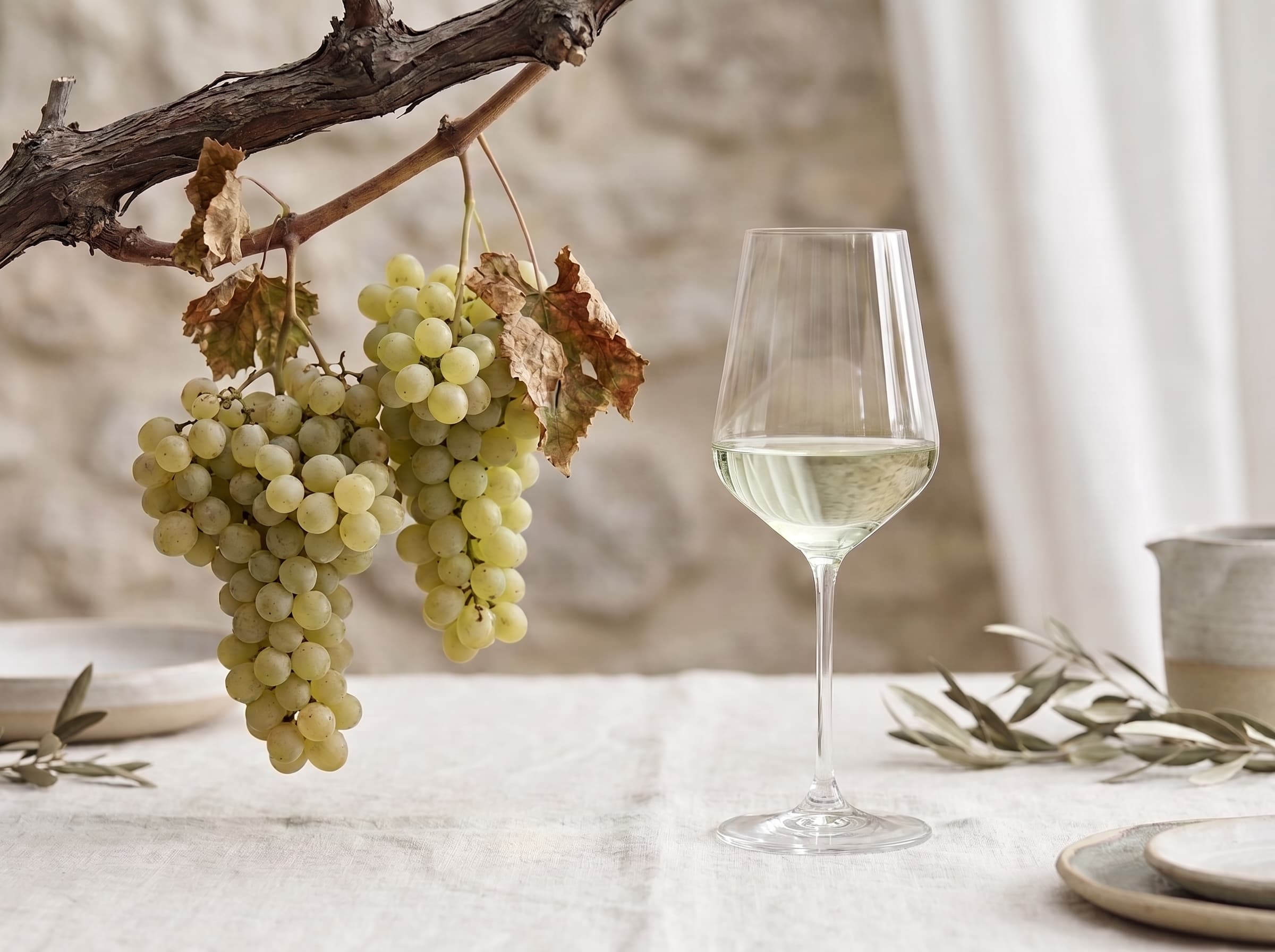
Mtsvane means "green" in Georgian, a plain description of the pale emerald hue on the vine.4 That directness is almost misleading, because everything else about this grape resists easy summary. It grows in six or more named regional variations, produces two very different wine styles, and has an origin story that no source can fully pin down.
Key Takeaways
- Mtsvane means "green" in Georgian, referring to the pale emerald color of the grape on the vine, which becomes a pale straw or light green tinted white wine.4
- The grape's aromatic profile centers on green apple, citrus zest, and white flowers, backed by a vibrant acidity, a combination that earned it the informal nickname "Georgian Riesling".124
- Mtsvane's exact origin can't be pinned down due to a lack of historical documentation, though one source places it as native to Georgia's Kartli and Kakheti regions.45
- More than six named regional variations exist, with Manavi Mtsvane, Goruli Mtsvane, and Kakhuri Mtsvane the most commonly recognized.4
- The grape is made into two distinct styles: a light, fruity classic white and a fuller-bodied Kakhetian style aged in qvevri after five to six months of skin contact.4
What's in a name
The grape's color gives it its identity. Mtsvane clusters carry a light green cast that becomes, in the glass, a pale straw or light green tinted white wine.4 The aromatic profile leans toward green apple, citrus zest, and white flowers, with a vibrant, almost electric acidity running underneath.12 That combination of freshness and floral lift is what earned Mtsvane the informal nickname "Georgian Riesling" among winemakers, a comparison about style and drinking experience rather than any genetic relationship between the two grapes.4
Mtsvane's thick skins offer natural protection from sun damage, and that same toughness translates into the grape's characteristic acidity, which carries through into finished wine.5 Sugar levels at harvest can reach 22% in Telavi and exceed 24% in southeastern Kakheti, giving winemakers real flexibility in style and ripeness.4
An origin nobody can fully document
Here the honest answer is: we don't know, not precisely. One source describes Mtsvane as native to Georgia's Kartli and Kakheti regions, cultivated for centuries.5 Another is more cautious, pointing out that the lack of historical documentation makes it genuinely difficult to establish where or when Mtsvane arose.4 What ampelographers do agree on is that the grape's biological traits suggest ancient lineage, since older varieties tend to show more variation from centuries of environmental pressure.4
That variation shows up today as distinct regional types. Manavi Mtsvane, Goruli Mtsvane, and Kakhuri Mtsvane are the most commonly recognized, out of more than six named variations grown across Georgia.4 Each carries the name of its home district, a naming convention that mirrors how Georgian viticulture has always organized itself: by village and microclimate rather than by a single standardized grape.
Where it grows, and why it's picky
Mtsvane favors altitude and a temperate climate, which narrows its comfortable range within Kakheti considerably. It's concentrated in Telavi, Sagarejo, and parts of Akhmeta and Gurjaani, with a smaller presence in Sighnaghi and Tsiteltskaro, and almost none in Lagodekhi or Kvareli.4 Vines reach their first harvest within three years of planting and are known for both strong quality and relatively generous yields, a rare combination.4
Beyond Georgia, Mtsvane has reportedly found a foothold in Armenia, Azerbaijan, and parts of Eastern Europe, though details on how or when that spread happened aren't well documented.5 Within Georgia, it's a fixture in village-labeled bottlings from Akhmeta, Manavi, Ikalto, Ruispiri, Napareuli, Tsinandali, and Vazisubani,4 each place name functioning almost like an appellation of its own.
Two wines from one grape
Mtsvane's real versatility shows in how differently it can be made. The classic style produces a light green wine with a lifted, fruity nose and a soft, harmonious palate, the version most likely to earn the Riesling comparison.4 The Kakhetian style takes the same grape in the opposite direction: full skin contact for five to six months, followed by fermentation and aging in qvevri, producing a deeper-colored wine with a fuller structure and a more complex fruit character.4 This second approach follows the traditional method described in our qvevri fermentation piece, and it's the same skin-contact logic behind amber winemaking more broadly.
Amber-style Mtsvane, made on skins and stems, brings out dried fruit, spice, and honey notes with a richer texture and more noticeable tannin.5 It's a useful reminder that in Georgia, "white grape" doesn't dictate a single style of wine. It's a starting point.
Mtsvane also shows up constantly in blends, most often alongside Rkatsiteli, in ratios ranging from equal parts to small supporting portions, and sometimes joined by Kisi, Khikhvi, Saperavi, or Zhghia.5 That flexibility as a blending partner, paired with its ability to stand alone, is part of why it remains a staple of Kakhetian white winemaking rather than a niche curiosity.
At Lanchava, Saba is our expression of Mtsvane on its own: light yellow with a greenish hue, soft but vivid, true to the grape's classic Kakhetian character.
Frequently Asked Questions
Is Mtsvane actually related to Riesling?
No, the "Georgian Riesling" nickname is a comparison of style and drinking experience, not a genetic link between the two grapes.4
How long before Mtsvane vines produce a harvest?
Mtsvane vines reach their first harvest within three years of planting, and the variety is known for combining strong quality with relatively generous yields.4
What does amber-style Mtsvane taste like?
Made on skins and stems, amber Mtsvane develops dried fruit, spice, and honey notes, with a richer texture and more noticeable tannin than the classic style.5
What other grapes is Mtsvane blended with?
Mtsvane is most often blended with Rkatsiteli, in ratios ranging from equal parts to a smaller supporting portion, and sometimes joined by Kisi, Khikhvi, Saperavi, or Zhghia.5
Sources
1. Goruli Mtsvane – Grape Insights - grapeminds 2. Mtsvane | MORE Natural Wine 4. Mtsvane Grapes – Tours to Uzbekistan & Central Asia & Caucasus 5. Mtsvane | Gvinico B2B Wine Marketplace