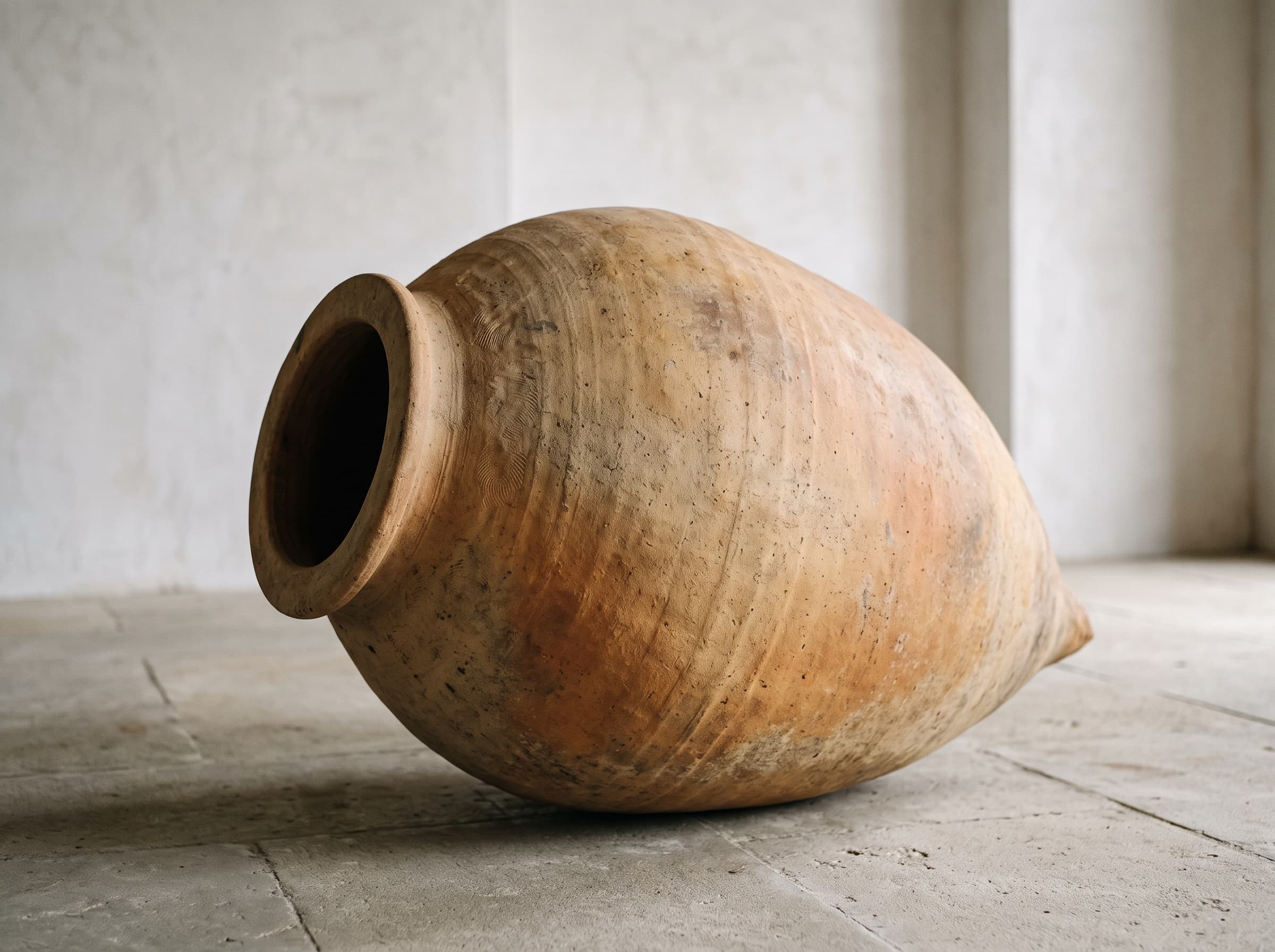
If you came across the word "qvevri" through a natural or orange wine list, there's a decent chance it was translated for you as a "Georgian amphora." That shorthand is everywhere, and it's not quite right. A qvevri and an amphora solve different problems, and the difference changes what ends up in your glass.
Key Takeaways
- A qvevri is a large, handmade earthenware vessel buried in the ground for fermenting, ageing, and storing wine, and its name comes from the Georgian root for "beneath" or "under".7812
- Unlike Mediterranean and Spanish amphorae, which were built with handles for transport and moved from place to place, a qvevri is never meant to leave the ground once it's installed.87
- A 2024 study in the journal Antiquity compared ancient Roman dolia with Georgian qvevri winemaking and found both were precisely built vessels shaped around producing specific wine outcomes, even though the traditions developed independently.1
- Burying a qvevri to the neck keeps the surrounding clay at a steady, cool temperature, which is part of how Georgian winemakers manage fermentation without mechanical refrigeration.127
- Georgia's amber (orange) wine category grew directly out of qvevri fermentation, where white grapes ferment on their skins, seeds, and sometimes stems for extended periods.104
What Is a Qvevri, and What Does the Word Mean?
A qvevri (ქვევრი, sometimes spelled kvevri) is a large, egg-shaped clay vessel used to ferment, age, and store wine.812 The word itself carries a clue to how it's used: the Georgian prefix "kve" means "beneath" or "under," pointing to the fact that these vessels are almost always buried.7
Qvevri are handmade, traditionally built up by coil rather than thrown on a wheel, then fired at high temperatures.128 Once formed, the interior is typically lined with beeswax to seal the porous clay and make cleaning easier, though some modern qvevri use epoxy resin instead, a substitution traditionalists tend to avoid.128 Before each use, the vessel is cleaned, traditionally with a lime slurry.12
Is a Qvevri the Same Thing as an Amphora?
No, and the distinction is about function, not just appearance. "Amphora" is a broad term for ancient clay vessels from Greek and Roman winemaking traditions, and it covers a range of regional forms still used today, including Italian giare and, by some accounts, Spanish tinajas.12 Most of these were built with handles because they were meant to be carried, stacked, and shipped.8
A qvevri was never designed to move. It's buried to the neck and becomes a fixed part of the cellar, called a marani, rather than a portable container.87 That permanence is the core difference a wine-education source points to when it calls the "Georgian amphora" label technically inaccurate.8
The comparison has gotten serious academic attention, too. A 2024 study in Antiquity looked at ancient Roman dolia (large fixed earthenware fermentation vessels) alongside Georgian qvevri winemaking, and found that the Roman vessels were, in their own right, engineered in composition, size, and shape to produce wines with particular sensory qualities.1 The takeaway isn't that one tradition copied the other. It's that burying and fixing a large clay vessel in place, rather than using it for transport, shows up independently in more than one ancient winemaking culture, with qvevri as the version that never stopped being used.121
How Does Shape and Burial Change the Wine?
A qvevri's large-bellied, egg-like shape with a narrower base isn't decorative. It's said to encourage the must to move more freely inside the smooth clay walls than it would in a straight-sided tank, which helps distribute skins, seeds, and stems through the liquid during fermentation.7 The same shape is credited with setting up gentle natural convection that keeps wine and lees in contact without stirring.12
Burial does real temperature work. Surrounded by earth, a qvevri is often described as holding at a fairly constant 13 to 15°C, which lets fermentation and ageing proceed without refrigeration.12 That said, fermentation itself generates heat: one Georgian winemaking consultant reports that larger, roughly 2,000-litre qvevri can run closer to 28 to 30°C during active fermentation, while smaller, around 200-litre qvevri ferment cooler, near 22 to 24°C, with the hotter end favoring more tannin and structural extraction and the cooler end favoring fresher fruit.7
Qvevri sizes vary by source. One wine-education account puts the modern range at roughly 50 to 3,500 litres.10 The clay itself is generally treated as neutral, meaning it isn't expected to add flavor or tannin the way an oak barrel might, though whether trace minerals in the clay influence the wine at all remains an open question among winemakers.7
Why Does This Matter for Orange Wine?
If you found your way to qvevri through orange wine, this is the connection point. In Georgia, "Amber Wine" is the specific category made from white grapes fermented in qvevri together with their skins, seeds, and sometimes stems, often staying on skins for one to six additional months after fermentation finishes.10 A 2023 review of orange winemaking traces the broader style's roots back to this Georgian method, noting that extended skin contact raises the presence of phenolic compounds that shape a wine's color, texture, and how it behaves as it ages.4 A 2019 study of skin-contact white wines measured total polyphenol and catechin content alongside color intensity as part of documenting that extraction.5
None of this makes the wine healthier or implies a benefit beyond the glass. It's simply a measurable difference in how much skin material a wine picks up, and for how long, which is the mechanism behind amber wine's deeper color and firmer texture compared to a white fermented off its skins.
At Lanchava Collection, this same buried-qvevri approach sits at the center of how we make wine in Kakheti. Our Amber, a dry skin-contact white made from 100% Kisi, follows the traditional qvevri method described here, and it's a good place to taste the difference this vessel makes firsthand. You can read more about our family's collection on our Our Story page, or see the full range in our Wine Collection.
Frequently Asked Questions
Is a qvevri the same word as an amphora?
No. "Amphora" is a general term for ancient Greek and Roman clay vessels, usually built with handles for transporting goods, while "qvevri" refers specifically to the Georgian vessel that is buried permanently and never moved once installed.812
How big is a qvevri?
Estimates vary by source. One wine-education account lists a modern range of roughly 50 to 3,500 litres, while other sources describe larger classic ranges, so exact capacity depends on which producer and region you're looking at.10
How old is qvevri winemaking in Georgia?
The earliest biomolecular evidence of grape winemaking comes from Neolithic sites in Georgia dated to roughly 6,000 to 5,800 BC.2 The commonly cited "8,000 years" figure is a rounded, popularized number rather than an exact study finding, though it reflects the same long, continuous tradition.107
Can orange wine be made without a qvevri?
Yes. The skin-contact technique at the heart of orange wine traces its roots to Georgian qvevri winemaking, but producers around the world now apply extended skin contact in other vessels, including stainless steel and various amphora-style containers.4
Sources
1. LIMBERGEN and Komar (2024). Making wine in earthenware vessels: a comparative approach to Roman vinification. Antiquity. 2. McGovern et al. (2017). Early Neolithic wine of Georgia in the South Caucasus. Proceedings of the National Academy of Sciences. 4. Buican et al. (2023). "Orange" Wine—The Resurgence of an Ancient Winemaking Technique: A Review. Agriculture. 5. Bene and Kállay (2019). Polyphenol contents of skin-contact fermented white wines. Acta Alimentaria. 7. Qvevri wines from Georgia: A winemaking story and 12 wines to try | Decanter 8. Qvevri: The ancient vessel at the heart of Georgian winemaking | Wine & Spirit Education Trust 10. Exploring Georgian wine: history, grape varieties, styles and amber wine | Wine & Spirit Education Trust 12. Qvevri: Georgian Wine Amphorae & Traditional Winemaking | Grape Guru