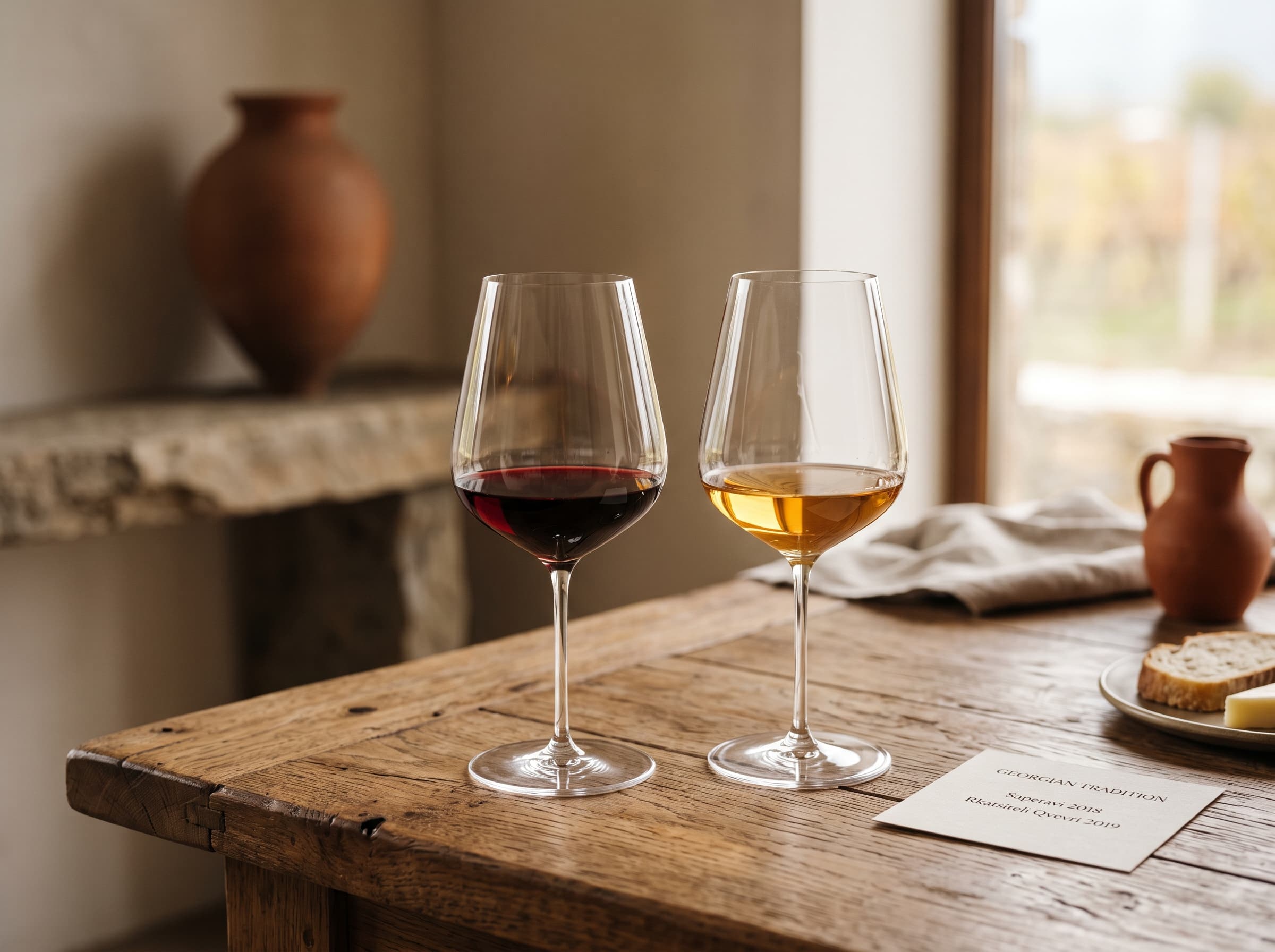
Type "famous Georgian wine" into a search bar and the same handful of names surface across travel guides, wine societies, and award lists. The overlap is not a coincidence. It reflects a country where two grapes, one region, and one ancient vessel account for most of what reaches a glass.
The honest answer is that there isn't a single famous Georgian wine. There's a short list, and the list has a clear order.
Key Takeaways
- Saperavi, Georgia's best-known red grape, is a teinturier variety whose name means "colouring," reflecting the deep pigment it releases when pressed.24
- Rkatsiteli is the most widely planted grape among Georgia's white varieties, which make up roughly three-quarters of all grapes grown in the country.4
- Kakheti produces the majority of Georgian wine, with estimates ranging from about 70% to 80% depending on the source.245
- The first bottles of Georgian wine were corked at Tsinandali Estate in Kakheti back in 1841.5
- At the IWSC 2024 awards, a Rkatsiteli-based orange wine scored 97 out of 100 and a Saperavi red scored 96 out of 100.3
Saperavi and Rkatsiteli lead every list
Saperavi is consistently named as Georgia's best-known red grape, though even that framing gets debated rather than settled. Its name comes from the Georgian word for "colouring," a reference to how much pigment it releases when pressed.24 It's a teinturier variety, meaning the flesh itself carries color, not just the skin, and it's hardy enough to thrive in Kakheti's colder pockets while still yielding well.2
Rkatsiteli carries the white side of the conversation. Its name translates to "red horn," and it's the grape most associated with Georgia's white wine identity, particularly in the Alazani Valley.2 About three-quarters of the grapes grown in Georgia are white varieties, with Rkatsiteli the most planted among them.4 Left to ferment normally, it produces something light and crisp. Left in qvevri with its skins and seeds, it becomes something else entirely: Georgia's amber wine, made using a method that predates modern winemaking by thousands of years.42
Our George (100% Rkatsiteli, dry, Kakheti) and Luka (100% Saperavi, dry, Kakheti) sit at exactly this intersection, the two grapes most travel writers and wine societies point to first when asked what Georgia is known for.
Why almost every answer traces back to Kakheti
Kakheti isn't just one region among several. It's where the majority of Georgian wine actually comes from, with estimates ranging from roughly 70% to 80% depending on the source.245 The precise figure shifts by publication, but the direction doesn't: if a wine is famous in Georgia, there's a strong chance it was grown here.
The region's dominance isn't recent. The first bottles of Georgian wine were corked at Tsinandali Estate in Kakheti in 1841,5 and Kakheti remains the center of qvevri winemaking, a method that buries clay vessels to the neck and lets the entire fermentation and maturation process happen inside them, often with skins and stems left in contact with the wine.2 UNESCO has given this practice protected heritage status.25
Our Kakhetian wines, George, Luka, Saba (100% Mtsvane), Anastasia, AI IA Red, and AI IA White, all draw from this same ground. It's worth noting Mtsvane as a third pillar here too: alongside Saperavi and Rkatsiteli, it's one of the indigenous whites most commonly grown in the region.4
The semi-sweet exception that surprises newcomers
Ask a Georgian which wine is famous and you'll often get an answer that has nothing to do with dry reds or ambers: Khvanchkara. It's a semi-sweet red from Racha, reportedly Joseph Stalin's favorite,2 made using a traditional method where cold mountain temperatures interrupted fermentation naturally, leaving sugar behind. Today, that same style is achieved with temperature-controlled tanks.2
Kindzmarauli follows a similar logic from Kakheti. Both wines occupy a category that Western wine culture doesn't have a strong equivalent for, and both are frequently cited alongside Saperavi and Rkatsiteli as answers to the "most famous" question.2
Our Nicholas (Alexandrouli and Mujuretuli, semi-sweet, Racha) and Anastasia (semi-sweet Saperavi, Kakheti) sit inside this tradition, offering the sweeter, rounder style that many first-time Georgian wine drinkers reach for before moving toward the dry reds.
The awards that back up the reputation
Reputation is one thing; recent recognition is another. At the IWSC 2024 awards, a Rkatsiteli-based orange wine scored 97 out of 100, described with notes of golden raisins, baked pastry, and warm apricot.3 A Saperavi red scored 96 points in the same competition, noted for liquorice, plum, and spice.3
Those scores matter because they're not nostalgia. They're a contemporary confirmation that the grapes Georgians have leaned on for millennia, Saperavi, Rkatsiteli, and the amber style built from qvevri fermentation, still hold up against the rest of the world's wine.
If you're curious where that skin-contact tradition shows up in our own collection, our Amber (100% Kisi, dry, Kakheti) is made using the qvevri method directly, alongside Mariné (semi-sweet Kisi) for a softer version of the same grape.
A short answer, if you need one
If someone asks which wine Georgia is famous for, the fair answer is: Saperavi for red, Rkatsiteli for white and amber, and Khvanchkara or Kindzmarauli if the conversation turns to semi-sweet. Almost every reputable source, from wine societies to travel guides to international competitions, keeps circling back to that same trio.2345 You can read more about our full lineup on the collection page, or see where the family's approach to these grapes began on our story page.
Frequently Asked Questions
What is qvevri winemaking?
Qvevri winemaking is a method that buries clay vessels to the neck and lets fermentation and maturation happen entirely inside them, often with skins and stems left in contact with the wine.2 Kakheti remains the center of this practice, which UNESCO has given protected heritage status.25
What is Khvanchkara?
Khvanchkara is a semi-sweet red wine from the Racha region, reportedly Joseph Stalin's favorite.2 Traditionally, cold mountain temperatures interrupted fermentation naturally and left sugar behind, though today the same style is achieved with temperature-controlled tanks.2
What is Kindzmarauli?
Kindzmarauli is a semi-sweet red wine from Kakheti that follows a similar winemaking logic to Khvanchkara.2 It's frequently cited alongside Saperavi and Rkatsiteli when people are asked to name Georgia's most famous wines.2
Does Georgia grow more white or red grapes?
Georgia grows more white grapes overall, with white varieties accounting for about three-quarters of what's planted, and Rkatsiteli is the most common among them.4
Sources
2. Best Georgian Wines 2024: Award-winning wines from Georgia - Club Oenologique 3. Our Guide to Georgia's Kakheti Wine Region | Jacada Travel 4. Tbilisi Wine Guide: Best Wine Tastings, Bars & Shops - Wander-Lush 5. Three Cheers for Saperavi and Georgia's Wine Market Miracle - Wine Economist