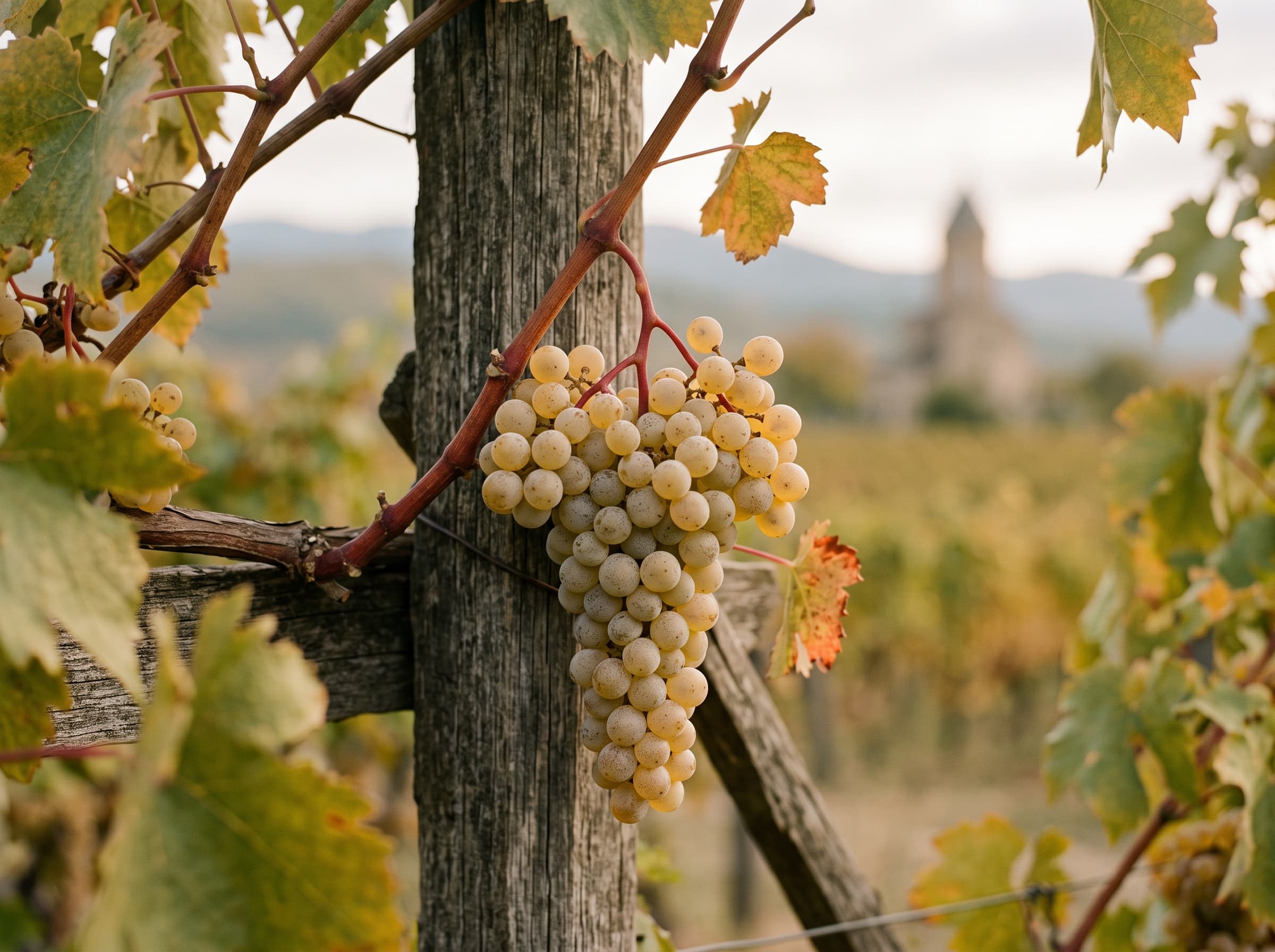
Rkatsiteli is Georgia's leading white wine grape, native to the eastern region of Kakheti.1 Made fresh, it gives crisp, dry whites with green apple, quince and citrus over bright acidity.12 Fermented on its skins in clay qvevri, it becomes amber wine, with honey, apricot, spice and tannin.1 It is also made semi-sweet, fortified and sparkling.12
It is planted far more widely than its fame suggests: about 51,000 hectares worldwide in 2021 figures, roughly half of them in Georgia.3
Key Takeaways
- Rkatsiteli is Georgia's leading white wine grape, native to Kakheti; its name means "red stem".12
- Made fresh it is a crisp dry white with green apple, quince and citrus; fermented on its skins in qvevri it becomes amber wine, with honey, apricot and tannin.12
- It is mostly made dry, and Georgian sources describe its acidity as bright, holding even as the grapes ripen.12
- About 51,000 hectares were planted worldwide in 2021, roughly half in Georgia; in the United States it grows mainly in New York's Finger Lakes and Virginia.31112
Rkatsiteli at a glance
| Trait | Rkatsiteli |
|---|---|
| Grape | White wine grape with green-gold berries, native to Georgia12 |
| Name | Georgian რქაწითელი, "red stem": rka means vine cane, tsiteli means red12 |
| Say it | ruh-KAT-see-TELL-ee4 |
| Wine color | Pale straw made fresh; dark straw, golden or amber made on its skins56 |
| Acidity | Bright; it keeps its acidity as it ripens12 |
| Typical aromas | Fresh: green apple, quince, pear, citrus, wild herbs, light floral notes. Qvevri: honey, apricot, dried orange peel, spice12 |
| Styles | Dry white, amber (qvevri), semi-sweet, fortified, sparkling; also eaten as a table grape12 |
| Season | Buds late (end of April), ripens late (early October)1 |
| Main region | Kakheti, home to 60 to 70 percent of Georgia's vineyards; also Kartli17 |
| Plantings | About 43 percent of Georgia's vineyards, over 20,000 hectares as of 2014;1 about 51,000 hectares worldwide in 20213 |
| Also grown in | Russia, Ukraine, Bulgaria, Moldova, Kazakhstan, Romania, France and the eastern United States, including New York and Virginia346 |
Fresh or amber: Rkatsiteli's styles compared
Rkatsiteli is quiet on the nose rather than showy.1 Its strength is structure: freshness, a mineral backbone and medium to full body.2 It is the base of several Georgian styles, and the two main ones are very different wines.2
| Style | How it is made | What it tastes like |
|---|---|---|
| Dry white (European style) | Fermented cool, usually in stainless steel, with little or no skin contact, and bottled young; some premium wines see oak or acacia28 | Pale straw; green apple, quince, pear, citrus and light floral notes; crisp, with a mineral backbone.12 Most drink best within 3 to 5 years3 |
| Amber (Kakhetian qvevri) | Fermented in buried clay qvevri with its skins, pips and stalks, then left on them until spring59 | Dark straw to amber; honey, apricot, dried orange peel and spice; more powerful, with tannin and crisp acidity15 |
| Semi-sweet | Late-harvest grapes, or must that is only partly fermented2 | Some of the grape's natural sugar stays in the wine |
| Fortified and sparkling | Fortified in the Kardenakhi appellation; also made sparkling12 | Its acidity and balance suit both styles2 |
Taste the two main styles side by side and you see what skin contact does to a white grape. Georgians call these skin-fermented whites amber wine, not orange wine, and the name matters.
On acidity. Georgian sources describe Rkatsiteli as keeping bright acidity even in warm years, building sugar without losing freshness,12 and France's Plantgrape agrees.6 Wine Folly reads it differently, reporting a harvest pH often around 3.8 and calling the acidity moderate to low.3 Site, picking date and winemaking all shape how it shows in the glass.
Rkatsiteli in Kakheti
Rkatsiteli is native to Kakheti and grown throughout the region, as well as in Kartli.1 Kakheti holds 60 to 70 percent of Georgia's vineyard area,7 and Rkatsiteli is the principal grape in most of its white wines.1 Georgia's National Wine Agency names Alazani Valley villages such as Kondoli, Tsinandali, Kisiskhevi, Vazisubani and Mukuzani as the places where it is arguably most expressive.1
It is an obliging vine. It is not fussy about site, comes through most winter frosts, and resists downy mildew well in dry Kakheti, less so in Georgia's humid west.1 It builds sugar while holding its acidity, so modern bottlings easily reach 13 percent alcohol.1
Because its aromatics are quiet, Rkatsiteli is often blended with a smaller share of Mtsvane, which adds lift and softness, in appellations such as Tsinandali, Gurjaani and Vazisubani.1 Tsinandali, mostly Rkatsiteli, is often described as the benchmark for Georgian dry whites.8 Rkatsiteli may also be a parent of a rarer Kakhetian white, Kisi: some researchers believe Kisi to be a natural crossing of Mtsvane and Rkatsiteli. The same valleys grow Saperavi, Georgia's principal red grape, and our guide to Georgian wine puts all of them in context.
What is the husk of Rkatsiteli grapes?
In Georgian winemaking, the husks are called chacha: the grape skins, pips and stalks.59 They are what turn Rkatsiteli amber. In the Kakhetian qvevri method, the whole chacha goes into the qvevri with the juice; in Imereti, at most a third does.5 Red wines stay on their chacha for 7 to 10 days, two weeks at most, but white wines such as Rkatsiteli stay on it until spring. That long contact gives a dark straw, golden or tea color, fruit tones and tannin.5 Georgia's traditional qvevri method was recognized by UNESCO as intangible cultural heritage in 2013.5
The word has a second meaning: chacha is also Georgia's grape spirit, distilled from this pomace.10
Name, age and history
The name means red stem, from rka, vine cane, and tsiteli, red, after the vine's reddish shoots.12 Rkatsiteli is one of Georgia's oldest varieties. Wineland links it to Georgian winemaking more than 3,000 years ago,2 though the National Wine Agency calls the time of its origin uncertain.1 Claims of an exact date, or of an older name for the grape, rest on evidence we could not verify.
Its spread beyond Georgia came in the Soviet era, when it became the main grape planted across the USSR and, for a time, one of the most planted white grapes in the world.3
Where is Rkatsiteli grown outside Georgia?
Worldwide, Rkatsiteli covered about 51,000 hectares in 2021. Georgia has roughly half, followed by Russia, Ukraine, Bulgaria, Moldova and Kazakhstan, according to University of Adelaide data cited by Wine Folly.3 It is also grown in Romania, with small plantings as far away as Australia,4 and in 2023 France added it to its official catalogue of vine varieties, with one certified clone.6
In the United States it has a small, long-standing place in the East:4
- New York. Dr. Konstantin Frank was the first to plant Rkatsiteli in the Finger Lakes, during his vine experiments of the 1950s and 1960s, and his winery still grows it on Keuka Lake.11
- Virginia. Virginia Wine lists it among the state's varietals, with notes of tropical fruit, honey and herbs,12 and it is one of about 30 grapes grown in the Monticello AVA around Charlottesville.13 Horton Vineyards, near Gordonsville in Orange County and inside the same AVA,14 is described as the first winery in Virginia to plant Rkatsiteli and make it as a varietal wine.15
- Elsewhere. Smaller plantings are reported in Massachusetts, New Jersey and North Carolina, with experimental vines in California and Colorado.4
Rkatsiteli in the Lanchava Collection
The Lanchava Collection has two Rkatsiteli wines, both dry, unoaked and from Kakheti. George is the fuller of the two: pale straw, with peach, citrus and mineral notes, a honeyed depth and refreshing acidity. AI IA White comes from younger vines, so it is lighter and fruitier, with yellow fruit and a hint of exotic citrus. If you like Pinot Grigio, either will feel familiar, though Rkatsiteli has more body and firmer acidity. For the qvevri side of Georgian white wine, our Amber is made from Kisi rather than Rkatsiteli, but it shows what the method does. Both Rkatsiteli wines are sold in the United States through Total Wine & More.
Frequently Asked Questions
What does Rkatsiteli taste like?
Made as a fresh dry white, Rkatsiteli tastes of green apple, quince, pear and citrus, with light floral notes and bright acidity.12 Made in qvevri on its skins, it turns amber, with honey, apricot, dried orange peel, spice and noticeable tannin.1
Is Rkatsiteli dry or sweet?
Usually dry. Georgia's National Wine Agency says it is mostly made in a dry style, though it is also made semi-sweet, fortified and sparkling.12
How do you pronounce Rkatsiteli?
Say ruh-KAT-see-TELL-ee.4 The name is Georgian, რქაწითელი, and means red stem, after the vine's reddish shoots.12
What is the husk of Rkatsiteli grapes?
In Georgia the grape husks are called chacha: the skins, pips and stalks.5 In Kakhetian qvevri winemaking, white wines such as Rkatsiteli stay on their chacha until spring, which gives them their amber color and their tannin.5
Is Rkatsiteli grown in the United States?
Yes, mostly in the East. Dr. Konstantin Frank first planted it in New York's Finger Lakes in the 1950s and 1960s,11 and in Virginia it grows in the Monticello AVA around Charlottesville, where Horton Vineyards is credited as the state's first varietal Rkatsiteli producer.1315
What wine is Rkatsiteli similar to?
In its fresh style, the closest familiar reference is a clean, dry, unoaked Pinot Grigio. Rkatsiteli has more body and firmer acidity, though, and its minerality leads the fruit.
Sources
1. White Wine Grape Varieties: Rkatsiteli, National Wine Agency of Georgia 2. Georgian grapes: Rkatsiteli, Wineland Academy 3. Rkatsiteli, Wine Folly 4. Rkatsiteli Grape Variety and Wine Profile, Winetraveler 5. Qvevri Wine, National Wine Agency of Georgia 6. Rkatsiteli, Plantgrape 7. Kakheti, Wineland Academy 8. Tsinandali PDO, Wineland Academy 9. Viticulture and Winemaking Regions, National Wine Agency of Georgia 10. A Drink to Last One Thousand Years, WIPO 11. 2023 Rkatsiteli technical sheet, Dr. Konstantin Frank Winery 12. Virginia Varietals, Virginia Wine 13. Monticello AVA, Wikipedia 14. Horton Vineyards, Wikipedia 15. Horton Vineyards Hosts International Rkatsiteli Day, Richard Leahy